Habit Chains
Link habits into a sequence.
Complete one, the next unlocks.
Stack 2–8 habits into a single chain — a Morning Power Hour, an evening wind-down, a post-work routine. Each chain runs as one ritual instead of a list of unrelated tasks, so momentum compounds across the sequence instead of dying between steps.
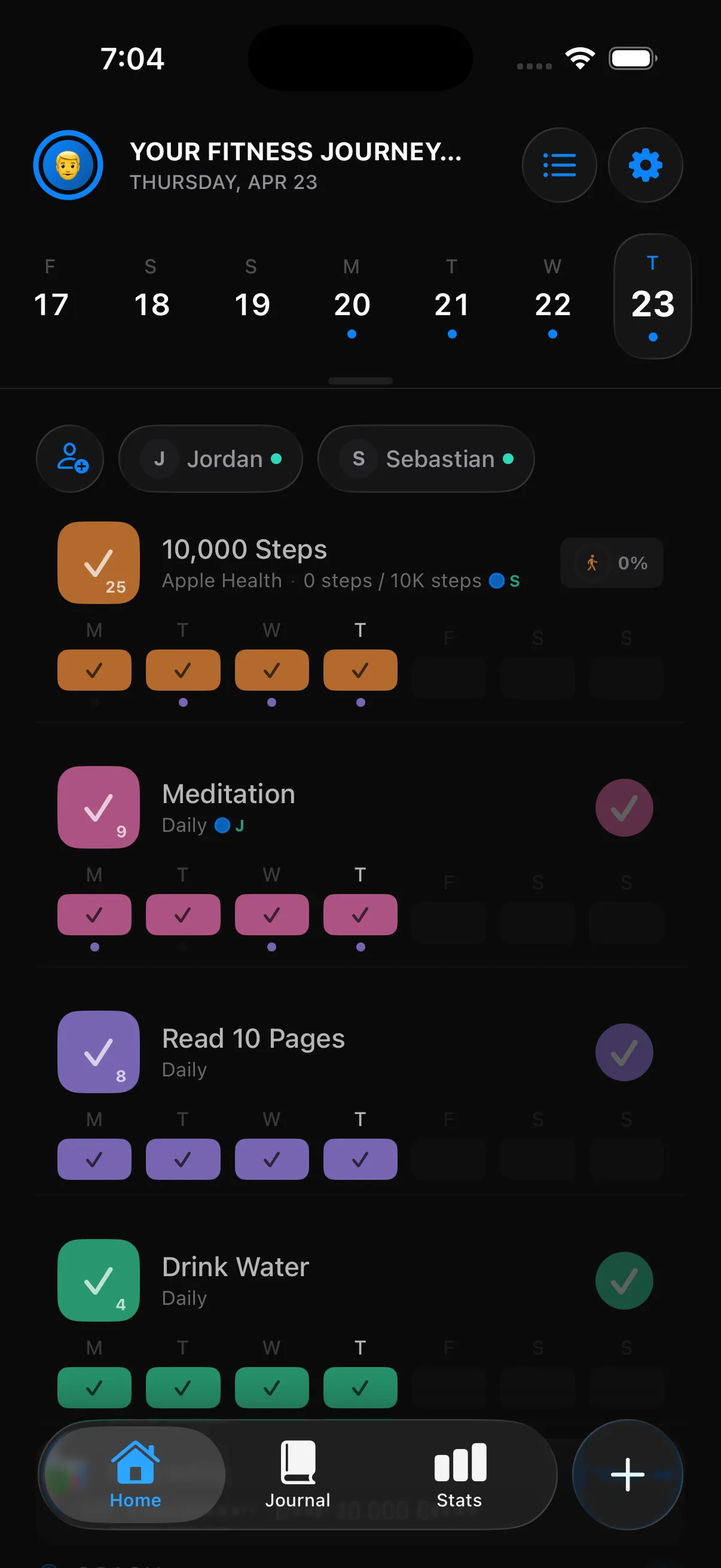

Anatomy of a chain
The canonical example most users build first is a Morning Power Hour:
- 5:30 AMWake upNo snooze. Feet on floor.↓
- 5:35 AM10-minute meditationAuto-tracked via HealthKit.↓
- 5:45 AM30-minute runApple Watch syncs the workout.↓
- 6:20 AMRead 20 pagesManual tap to confirm.↓
- 6:45 AMGreen smoothieManual tap to confirm.
Five habits, one ritual. The chain tracks its own completion rate (e.g., "87% chain completion this month") and chain streak — separate from the individual habit streaks. When all five complete in a day, the chain advances. If any one breaks, the chain doesn't complete that day, but each underlying habit still has its own streak running.
Why chains beat habit lists
A list of habits is a list of decisions. Every transition between two habits is a decision point where willpower has to step in: do I keep going or do I check my phone? A chain removes the decision — the next habit is the next thing on the chain, full stop.
This is a known finding in behavioral research. The "Implementation Intentions" work (Peter Gollwitzer, NYU) shows that specifying a sequence with concrete triggers roughly doubles follow-through compared to having the same goals as a loose list. The trigger for "meditate at 5:35" isn't motivation — it's "I just woke up." The chain provides the trigger automatically.
The other half is keystone-habit research: there's almost always one habit early in the day that, if you nail it, the rest follow. Chains let you put that keystone first — when wake-up + meditation lands at 5:35, the run at 5:45 is barely a decision anymore.
Common chain shapes
These are the patterns most users converge on after their first month. Steal any of them as a starting point.
-
Morning Power Hour
Wake → meditate → run → read → smoothie
-
Evening Wind-Down
No phone after 9pm → read → journal → lights out at 11
-
Post-Work Reset
Walk home → shower → cook at home → no scroll
-
Fitness Block
Hydrate → stretch → workout → protein → cool-down
-
Deep Work Start
Phone in drawer → coffee → 90-min focused block
-
Recovery Day
No alcohol → meditation → walk → journal
Frequently asked
-
How many habits can I put in a single chain?
Practically: 2 to 8. Two-habit chains work great for simple sequences (wake → meditate). Eight-habit chains are pushing it — by the time you're stacking that many habits, the chain itself becomes brittle and any one miss kills the whole sequence. The Morning Power Hour example most users gravitate toward sits at 4–5 habits, which seems to be the sweet spot.
-
Can chains include partner-paired habits?
Yes. Each habit in a chain can be solo or paired with a different partner. A chain of three habits could be paired with three different partners, or with one partner across all three, or any mix. The chain just orchestrates the order — partner mechanics still apply per habit.
-
What counts as 'completing' a habit in a chain?
Whatever you defined when you created the habit. HealthKit-eligible habits (workouts, meditation, hydration, sleep) auto-detect completion. Manual habits get a single tap to confirm. The chain just watches each habit's status and marks the chain complete when the last one in the sequence flips to done for the day.
-
Do I have to do them in order?
No — chains track completion, not strict sequencing. The visual progression (each habit unlocks the next) is a UI hint to keep the routine feeling momentum-driven, but if you do step 4 before step 2, the chain still completes for the day. The order matters for habit design, not enforcement.
-
What if I skip one habit in the chain?
The chain doesn't complete that day. The chain streak resets to zero. Individual habit streaks within the chain follow their own rules (each habit has its own streak that can include its own partner reset). This is intentional: chains are a momentum mechanic, not a punishment mechanic — missing a chain isn't worse than missing the underlying habit, it just means the routine didn't run that day.