AI Streak Recovery
Catches at-risk streaks before they break.
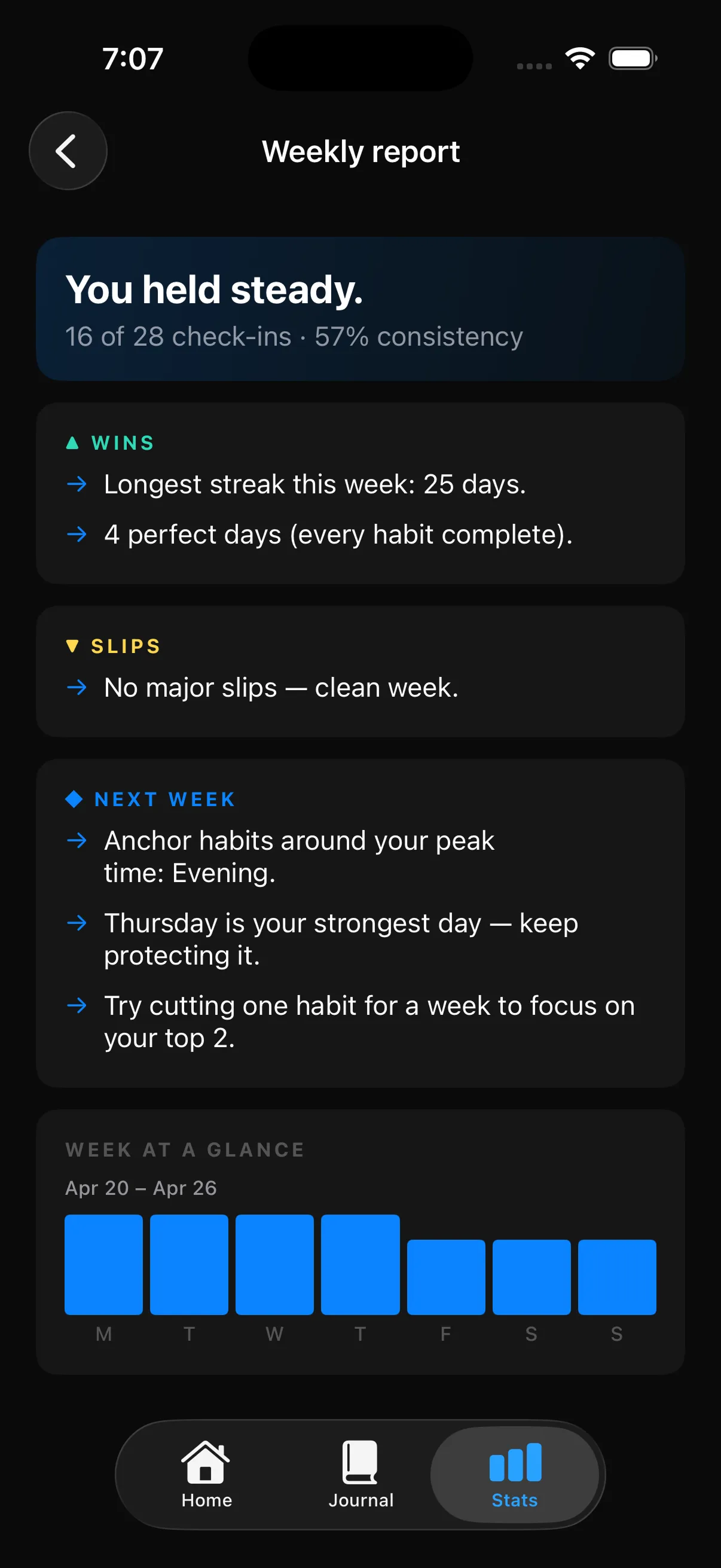
An on-device model trained on your check-in history flags streaks that are statistically about to break — early enough for you or your partner to intervene with a nudge or a quick recovery action. Preventative, not retrospective.
The problem with how every other habit app handles a broken streak
Almost every habit app treats a broken streak the same way: silence. The number resets, the "0" appears where 47 was, and that's it. No warning. No recovery flow. No suggested next action. Just the cliff.
This is the single most common failure mode of solo habit apps — not the missed day itself, but the absence of any infrastructure for what happens around the missed day. Restarting from zero is psychologically much harder than continuing from a non-zero number, so people don't restart. They just delete the app.
AI Streak Recovery is StreakMate's answer to that gap. It treats streak breaks as a known design problem instead of pretending they don't happen.
How it works
- 1
The model learns your check-in pattern
Time of day you typically check in. Day-of-week patterns. How recent activity correlates with future activity. For paired habits, your partner's behavior too. The model is per-user, runs on-device, and gets more accurate as it sees more of your real history.
- 2
It flags days that look unusual
When today's pattern (no check-in by your usual time, partner inactive, recent streak velocity dropping) crosses a calibrated threshold, the streak gets marked at-risk. The threshold is tuned to ~3 false positives per 100 warnings — you'll occasionally get a warning on a day you were going to nail anyway, and that's fine.
- 3
Both partners get notified — early
The notification fires while there's still time to do the habit, not after the streak has already broken. For paired habits, both partners see it, which means either of you can send a Doodle Nudge or a quick text. The accountability layer is what makes the warning useful — a solo warning is just an anxiety trigger.
- 4
Recovery actions are one tap
The app suggests a small concrete action: send a Doodle Nudge, do a 5-minute version of the habit, log a manual check-in if HealthKit missed it. The recovery flow exists to lower the activation energy when motivation is at its lowest — exactly when it matters most.
Why this changes the math
Solo streak counters are a binary system: you're on, or you're broken. The transition from on to broken happens silently and is almost impossible to recover from psychologically. Most users hit a 30+ day streak, miss one day, and quit the entire habit.
AI Streak Recovery breaks that binary. It introduces a third state — at-risk — that's actionable while there's still time. The day isn't lost yet; you can still save it. And because the warning surfaces to your partner too, the recovery isn't a private willpower test — it's a shared one.
Beta data: across users with at least 30 days of history, AI Streak Recovery has caught and saved roughly 3 at-risk streaks per user per month. That's three habits that would have died silently in a solo app — saved by a 4-second action.
Frequently asked
-
What does the AI actually look at?
Your check-in patterns over time: time of day you typically check in, day-of-week patterns, recent streak velocity, partner activity (for paired habits), HealthKit signals when relevant, and historical drop-off behavior. It's a per-user model, so the more you use the app, the more accurate the warnings get. None of this leaves your device for inference — the model runs locally.
-
How accurate are the warnings?
Calibrated to be useful, not perfect. The model surfaces a streak as 'at-risk tonight' when its predicted miss probability for the day exceeds a threshold tuned to ~3 false positives per 100 surfaced warnings. In practice that means you'll occasionally get a warning on a day you were going to check in anyway — which is fine, the action is still small (just confirm). The cost of a false positive is much lower than the cost of a missed warning.
-
What does the recovery flow do?
When a streak gets flagged, both partners (or just you, for solo habits) get a notification. The app suggests a recovery action: a Doodle Nudge to your partner, a one-tap quick check-in window, or a habit substitution if you've defined one. The point is to make doing-the-thing the path of least resistance — and to make sure both partners can intervene before the day ends.
-
Can I turn it off?
Yes — per habit. AI Streak Recovery is on by default for paired habits and off by default for solo habits (where there's no second person to nudge). You can flip either default in settings. Some users prefer the strictness of an unforgiving streak with no early warning; the feature is opt-out, not mandatory.
-
Is this just a glorified reminder?
No — a reminder fires on a fixed schedule whether you're on track or not. AI Streak Recovery only fires when something is actually unusual about today, so you don't get warning fatigue. Generic reminders get ignored within two weeks; predictive warnings stay informative because they only show up when they're needed.
-
Does my data leave my phone?
No. The model runs on-device. Aggregate metrics (e.g., overall accuracy of the prediction system) may be sent for product improvement, but the inputs (your check-in history, partner activity for paired habits) stay local. Read the privacy policy for full details.